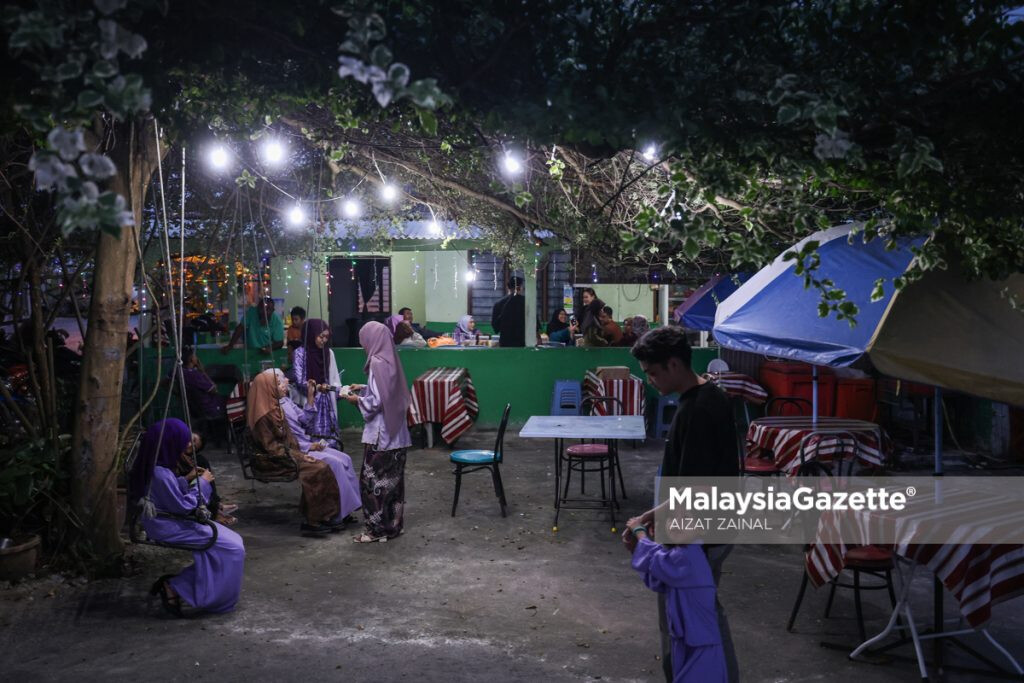
The atmosphere of the Hari Raya celebration with family and friends in conjunction with celebrating Hari Raya Aidilfitri on 2 Syawal, as observed by the MalaysiaGazette lens team during a survey in Kampung Kuala Sungai Baru, Puchong.
It has now been more than two weeks since Muslims entered the month of Syawal, sharing in the anxiety felt by the global community over the uncertainty of the world economic crisis—a result of the sudden spike in oil prices caused by the “evil hands” of the United States and Israel attacking Iran. Malaysia has also felt the impact, yet it has not diminished the festive spirit of the Hari Raya celebrations, which still remains vibrant.
Indeed, such is the noble character of our society, shaped by religious and family upbringing from a young age. Even with limited means, people still wish to share and celebrate the blessings and wisdom of Hari Raya with those near and far through open house gatherings. The writer believes that the eagerness to celebrate Syawal does not mean that the preceding month of Ramadan is unimportant or sidelined.
Both months are celebrated with different approaches because, traditionally and culturally—particularly in the Malaysian context—Muslims understand that Ramadan is a time to focus on increasing acts of worship and reaping multiplied rewards, while Syawal is filled with visiting one another and feasting.
Syawal is not merely a marker of the end of Ramadan; it carries the meaning of victory for Muslims, having successfully subdued their base desires, increased their worship, and improved their relationship with the Creator and with fellow human beings. For this reason, from long ago, the theme of Aidilfitri has captured the essence of joy, gratitude, and the uniting of hearts among Muslims.
It is in this context that Syawal is often associated with the meaningful expression: “Those who are far are brought close, and those who are close are drawn even nearer.” In truth, the wisdom of Syawal does not lie in the festivity of new clothes or the variety of dishes, but in the strength of family and kinship ties that are reinforced. Islam places great importance on maintaining family relationships, as the family institution—comprising parents, siblings, and relatives—is a trust that must be preserved with love.
This bond is not merely a matter of blood ties, but also a form of moral and religious responsibility. In modern life, often constrained by the busyness of work and daily commitments, family relationships can sometimes become strained without us realizing it. Thus, Syawal comes as a deeply meaningful opportunity to revive those ties.
The Quran itself emphasizes the importance of maintaining family bonds and kinship. Allah SWT says: “And fear Allah, through whom you ask one another, and honour family ties. Indeed, Allah is ever watchful over you.” (Surah An-Nisa’, verse 1).
In Malaysian Muslim society, the tradition of visiting one another during Aidilfitri is a highly valued practice. This custom not only strengthens the bonds between family members but also reinforces ties with relatives and old acquaintances. Open houses, family visits, and meetings with old friends become the grounds for renewing relationships that may have been broken for various reasons. For those who have migrated far from their hometowns, Syawal is a much-anticipated moment.
Therefore, it is not unusual to see many people willing to undertake long journeys just to return home to their parents and beloved families. The “balik kampung” (returning to one’s hometown) phenomenon that occurs every time Aidilfitri approaches actually illustrates how strong family values are in our culture. It is at this moment that those who are far are brought close again, and the longing that has been pent up for so long can finally be released.
Moreover, the practice of seeking forgiveness among family members, relatives, and acquaintances teaches people to lower their egos and open a new chapter in life. It cannot be denied that in the journey of life, people often make mistakes, whether consciously or not. Therefore, Syawal becomes the best opportunity to seek forgiveness and to forgive one another, in order to improve relationships among people, in line with the words of Allah SWT: “Let them forgive and overlook. Do you not wish that Allah should forgive your sins?” (Surah An-Nur, verse 22)
In addition, Syawal also serves as a time to expand friendships and acquaintances. Visiting neighbours, colleagues, and old friends strengthens the spirit of community togetherness. Good relationships with acquaintances and the surrounding community help to create a more harmonious and mutually supportive living environment.
In a world that is increasingly modern and rapidly changing, the value of kinship must not be allowed to fade. Technology and social media may make communication easier, but they cannot replace the value of human connection that comes through face-to-face meetings and visits. Therefore, the spirit of Syawal must continue to be harnessed to strengthen family, kinship, and friendship ties.
Indeed, the wisdom of Syawal lies in its ability to unite human hearts. It reminds us that family ties, relatives, and acquaintances are precious gifts. The celebration of Aidilfitri is not merely an annual festivity, but a reminder that a meaningful life rests on a good relationship with Allah SWT and harmonious relationships among fellow human beings. If the values learned throughout Ramadan continue to be preserved in Syawal and the months that follow, then Aidilfitri truly becomes the symbol of true victory for Muslims.