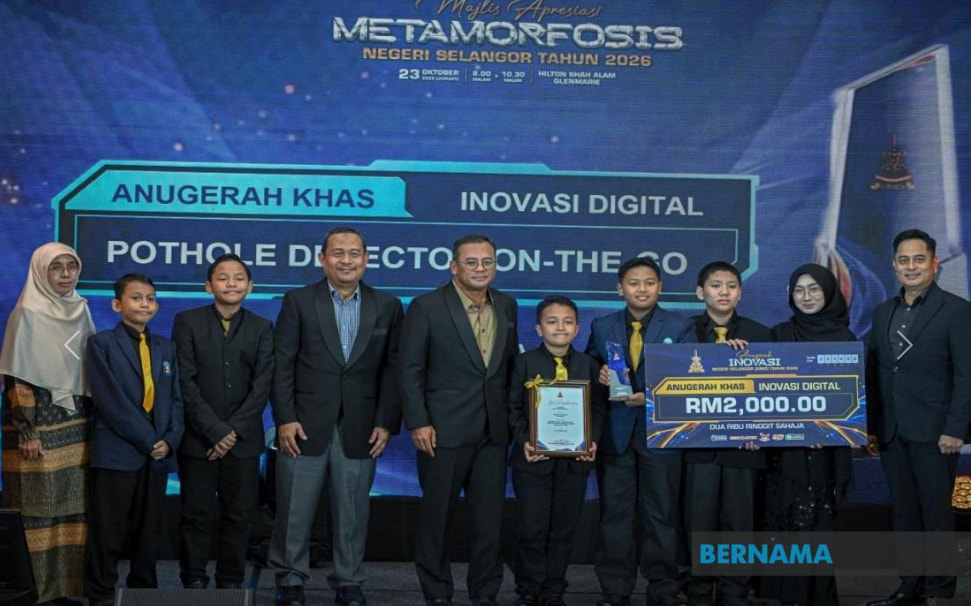
A team of five Year Six pupils from Sekolah Kebangsaan Puchong Utama 2 has developed an Internet of Things (IoT)-based device that detects road potholes, using a project budget of just RM114.
The team, known as Pasukan Harmoni, won the Special Award for Digital Innovation at the Selangor Metamorphosis Appreciation Ceremony 2026. Their invention competed against 240 participants, including representatives from universities, local authorities and private-sector organisations.
How Does the Pothole Detector Work?
The invention, called Pothole Detector On-The-Go, uses electronic components to identify road surface damage and send alerts to a monitoring system.
Its components include:
-
Ultrasonic sensors to detect road surface irregularities.
-
LED indicators and a buzzer to provide alerts.
-
A controller and other electronic components to process signals.
-
A monitoring system that can receive information about the detected pothole’s location.
The pupils began developing the project in July 2026, applying concepts learned in their school science lessons. <Cite refs={[“turn209668view0”]}/>
What Happens Next?
The school plans to continue developing the prototype by integrating cameras and artificial intelligence (AI). These upgrades could improve its detection capabilities and increase its potential for wider use.
The team received RM2,000 in prize money, a trophy and a certificate for the innovation award. The school has also expressed openness to collaboration with interested parties to further develop the invention. <Cite refs={[“turn209668view0”]}/>
Why Is This Relevant to Puchong?
Road potholes can affect motorists, motorcyclists and other road users. A system that detects damage and reports its location could potentially help maintenance teams identify problems more efficiently.
If further testing proves successful, similar technology could eventually support road monitoring by local authorities or maintenance contractors. However, the prototype’s real-world performance and commercial readiness have not yet been established.
The project also demonstrates how relatively inexpensive components can be used to explore practical engineering problems, opening possibilities for future student innovation and technology development.
Discussion
Would you like to see more schools in Puchong develop practical technology projects to solve local problems? What other issues around Puchong could benefit from affordable smart-city innovations?
Source: Bernama
Published Date: 2026-10-28T01:13:00Z