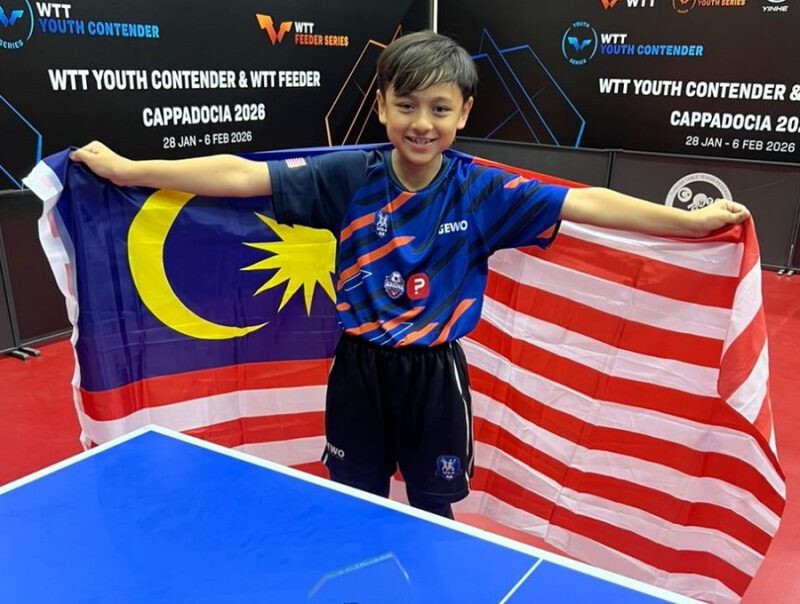
Meet Habib Adrian Muhammad Suhaidin Azhar, one of Malaysia’s brightest young hopes in table tennis.
At just 11 years old, the Puchong-born talent from Selangor has already competed on the international stage, even if his name is not yet widely recognised at home. This may be due to table tennis receiving far less attention in Malaysia compared to sports such as football, badminton and squash.
On Feb 2, the Kuala Lumpur Table Tennis Association announced via Facebook that Habib clinched the boys’ Under-11 title at the World Table Tennis Youth Contender in Cappadocia, Turkiye.
That same day, the International Table Tennis Federation released its latest Boys’ Under-11 world rankings, placing Habib second globally with 117 points. He trails only world No. 1 Taavi Samaraweera, who leads with 199 points.
Talent clearly runs in the family. Habib’s younger brother, Raden Zharif, who is a year his junior, has also captured multiple tournament titles.
As Malaysians celebrate Habib’s recent triumphs and impressive global ranking, a familiar concern resurfaces: can young talents like him maintain their momentum and succeed at the senior level?
Malaysia has previously produced several promising prodigies who struggled to transition into elite competition. Some blame the weight of expectations, while others highlight the lack of a comprehensive system to nurture and safeguard young athletes. Conflicts between parents and sporting authorities have also, in some cases, contributed to stalled progress.
Adding nuance to the discussion is a study published late last year which suggests that early brilliance is not necessarily a predictor of long-term excellence. The research examined data from 19 studies involving nearly 35,000 elite adults, along with findings from 66 additional studies on talented youth and sub-elite athletes.
The results showed that only about 10 per cent of world-class adults were outstanding performers in their youth. Likewise, just 10 per cent of high-achieving children went on to reach the pinnacle of their sport as adults.
Arne Güllich, the study’s lead author and a professor at RPTU Kaiserslautern in Germany, told New Scientist that many elite performers were not exceptional early on, suggesting that early success is not a requirement for future world-class achievement.
This perspective does not diminish the accomplishments of young athletes like Habib. On the contrary, their success already positions them as role models, inspiring other children to pursue sports.
The responsibility now lies with policymakers to adopt more thoughtful, evidence-based approaches to managing young talent. Opinions remain divided: some caution against placing children in centralised training programmes too early, fearing social and emotional drawbacks, while others advocate early exposure to competitive environments to sustain development.
Without guidance grounded in research, however, such debates remain largely speculative. Each athlete must be managed according to individual needs and capacity, rather than through one-size-fits-all assumptions.
Parents also require clearer direction on how best to support gifted children. Some may push too hard, driven by unrealised personal ambitions, while others may struggle to determine appropriate levels of training and competition.
As sports academies continue to expand across the country, reflecting growing parental interest in structured development pathways, clearer guidelines could help align expectations for families and young athletes alike.
For now, there is hope that adik Habib will continue to bring pride to his family and the nation. Beyond competitiveness, he should be allowed to enjoy the game — after all, he is only 11 and has a long journey ahead.
Whether Habib ultimately becomes a star at the highest level remains uncertain. What is clear, however, is that Malaysia can take pride in having a young table tennis talent ranked among the world’s best.
Source: twentytwo13
2026-02-10T16:00:00Z